Hello compassionate readers! As promised, this topic is going to be about what the heck meat has to do with the environment! Again, I can only include a fraction of the available information out there because there is SO much to say about this topic, but I’ll do my best.
GREENHOUSE GASES
- Animal agriculture is responsible for 18 percent of greenhouse gas emissions, more than the combined exhaust from all transportation.
- Transportation exhaust is responsible for 13% of all greenhouse gas emissions.
Greenhouse gas emissions from this sector primarily involve fossil fuels burned for road, rail, air, and marine transportation. - Livestock and their byproducts account for at least 32,000 million tons of carbon dioxide (CO2) per year, or 51% of all worldwide greenhouse gas emissions.
- Methane is 25-100 times more destructive than CO2 on a 20 year time frame.
- Methane has a global warming potential 86 times that of CO2 on a 20 year time frame.
- Livestock is responsible for 65% of all human-related emissions of nitrous oxide – a greenhouse gas with 296 times the global warming potential of carbon dioxide, and which stays in the atmosphere for 150 years.
- Emissions for agriculture projected to increase 80% by 2050.
- Energy related emissions expected to increase 20% by 2040.
- US Methane emissions from livestock and natural gas are nearly equal.
- Cows produce 150 billion gallons of methane per day. [xi]
- 250-500 liters per cow per day, x 1.5 billion cows globally is 99 – 198.1 billion gallons. Rough average of 150 billion gallons CH4 globally per day.
- Converting to wind and solar power will take 20+ years and roughly 43 trillion dollars.
- Even without fossil fuels, we will exceed our 565 gigatonnes CO2e limit by 2030, all from raising animals.
- Source: calculation is based on http://www.worldwatch.org/node/6294 analyses that 51% of GHG are attributed to animal ag.
- Reducing methane emissions would create tangible benefits almost immediately.
–WATER – - Fracking (hydraulic fracturing) water use ranges from 70-140 billion gallons annually.
- Animal agriculture water consumption ranges from 34-76 trillion gallons annually. [ii] [xv]
- Agriculture is responsible for 80-90% of US water consumption. [xv]
- Growing feed crops for livestock consumes 56% of water in the US. [xv]
- Californians use 1500 gallons of water per person per day. Close to Half is associated with meat and dairy products.
- 2,500 gallons of water are needed to produce 1 pound of beef.
– LAND –
- Livestock or livestock feed occupies 1/3 of the earth’s ice-free land.
- Livestock covers 45% of the earth’s total land.
- Animal agriculture is the leading cause of species extinction, ocean dead zones, water pollution, and habitat destruction.
“Animal agriculture contributes to species extinction in many ways. In addition to the monumental habitat destruction caused by clearing forests and converting land to grow feed crops and for animal grazing, predators and “competition” species are frequently targeted and hunted because of a perceived threat to livestock profits. The widespread use of pesticides, herbicides and chemical fertilizers used in the production of feed crops often interferes with the reproductive systems of animals and poison waterways. The overexploitation of wild species through commercial fishing, bushmeat trade as well as animal agriculture’s impact on climate change, all contribute to global depletion of species and resources.” http://www.cowspiracy.com/facts/
So as you can see, animal agriculture is destroying our environment. I will link an educational youtube video below.
https://www.youtube.com/watch?v=dSjE8xw_-Dg (Shorter version of cowspiracy)
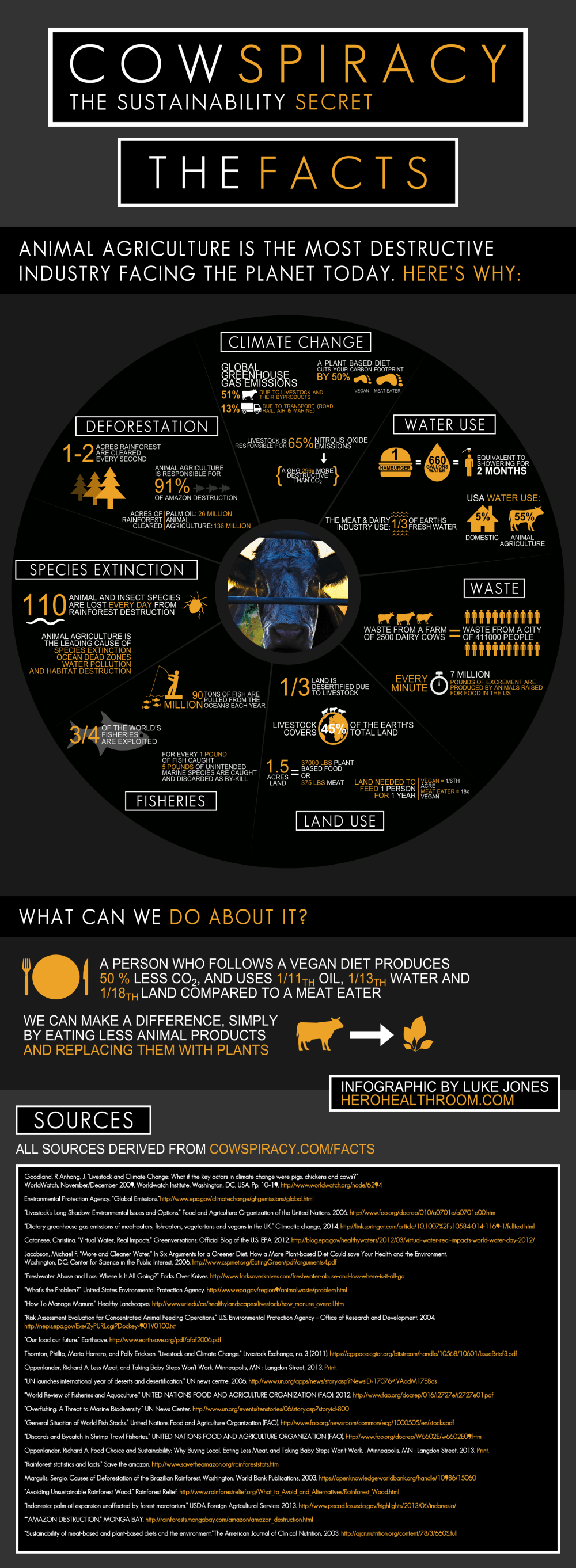
*This information was derived from the Cowspiracy website where they used the following sources to condense this information. You can view Cowspiracy on Netflix.
FAO. “Livestock a major threat to environment”
Thornton, Phillip, Mario Herrero, and Polly Ericksen. “Livestock and Climate Change.” Livestock Exchange, no. 3 (2011).
IPCC AR5 WG# Chapter 11, Agriculture, Forestry and Other Land Us (AFOLU)
Fao.org. Spotlight: Livestock impacts on the environment.
Pacific Institute, “California’s Water Footprint”
Jacobson, Michael F. “More and Cleaner Water.” In Six Arguments for a Greener Diet: How a More Plant-based Diet Could save Your Health and the Environment. Washington, DC: Center for Science in the Public Interest, 2006.
“USDA ERS – Irrigation & Water Use.” United States Department of Agriculture Economic Research Service. 2013.
Pimentel, David, et al. “Water Resources: Agricultural And Environmental Issues.” BioScience 54, no. 10 (2004): 909-18.
Barber, N.L., “Summary of estimated water use in the United States in 2005: U.S. Geological Survey Fact Sheet 2009–3098.”
“Draft Plan to Study the Potential Impacts of Hydraulic Fracturing on Drinking Water Resources.” EPA Office of Research and Development. United States Environmental Protection Agency, 2011.
U.N. Press Release, Climate Summit 2014.
The Cost Of Going Green Globally
Ross, Philip. “Cow farts have ‘larger greenhouse gas impact’ than previously thought; methane pushes climate change.” International Business Times. 2013.
EPA. “Overview of Greenhouse Gases.”
Energy Global Hydrocarbon Engineering
IEA, World Energy Outlook 2014
http://www.nature.com/nature/journal/v515/n7528/full/nature13959.html
“Livestock’s Long Shadow: Environmental Issues and Options.” Food and Agriculture Organization of the United Nations. 2006.
“Improved Attribution of Climate Forcing to Emissions.” Science Magazine. (Please note the following PDF is very large and may take a while to load)
WorldWatch, November/December 2009. Worldwatch Institute, Washington, DC, USA. Pp. 10–19.
Animal Feed Science and Technology “comment to editor” Goodland, Anhang.
The Independent, article Nov. 2009.
Environmental Protection Agency. “Global Emissions.”
Oppenlander, Richard A. Food Choice and Sustainability: Why Buying Local, Eating Less Meat, and Taking Baby Steps Won’t Work. . Minneapolis, MN : Langdon Street, 2013. Print.
Goodland, R Anhang, J. “Livestock and Climate Change: What if the key actors in climate change were pigs, chickens and cows?”
 All things vegan